

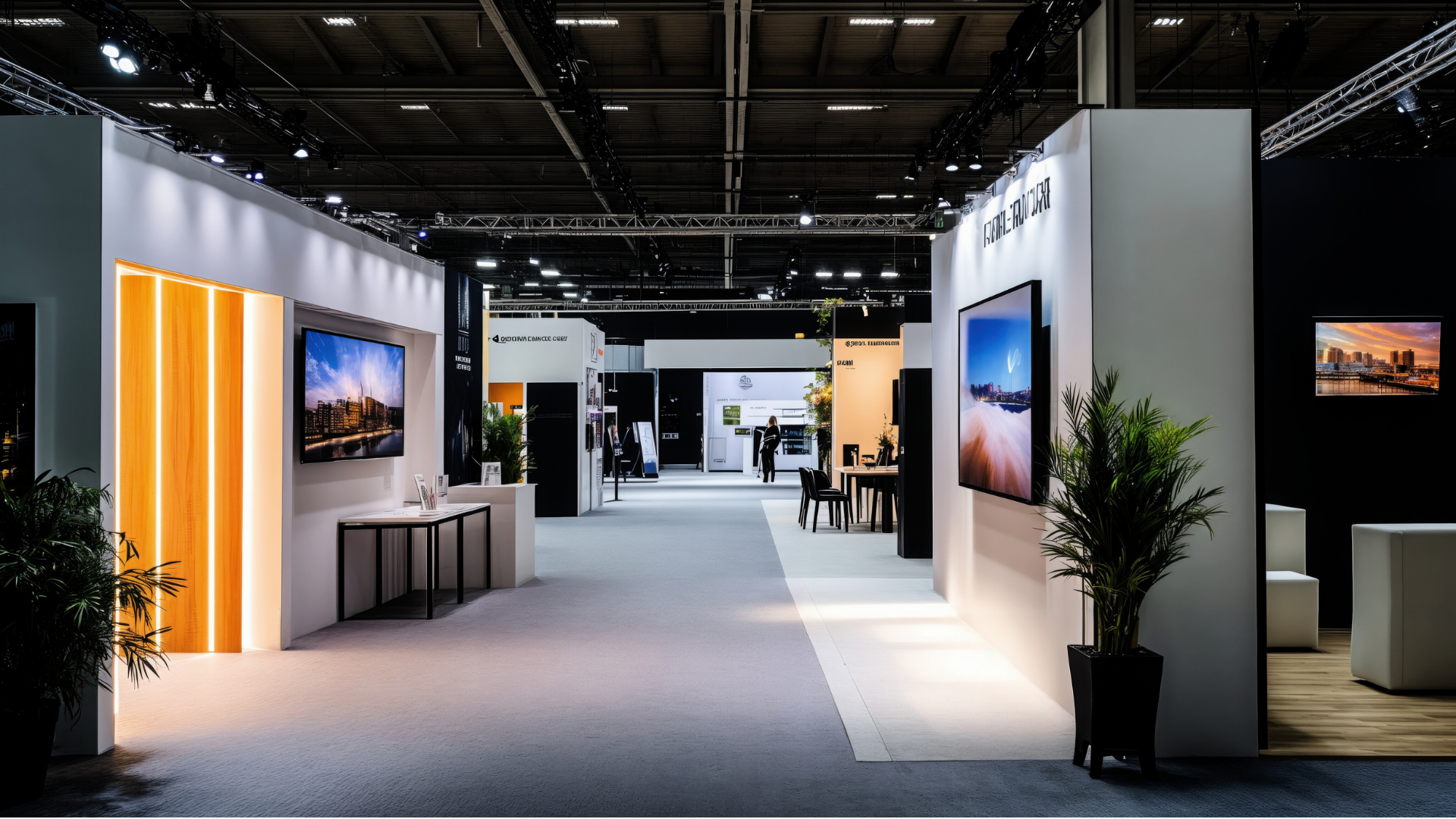
Summary: This article is about how the right floor tape helps visitors navigate an exhibition without having to ask staff or consult a map. It is written for production managers and technicians responsible for wayfinding and visitor flow at trade shows and events. The reader will find concrete solutions for color-coded walkways, precise arrow markings, and safety-critical signage that works throughout an entire exhibition day.
It's a situation that repeats itself at every major exhibition: visitors gather confused at a junction between halls, staff repeatedly give the same directions, and the flow to a popular stand or exit gets unnecessarily congested. Floor tape guiding visitors is about solving that problem before it arises, through clear visual cues that work without anyone needing to point. We often see exhibition organizers invest heavily in signage on walls and ceilings, while the floor – the surface visitors actually look at when walking – is left untouched. This is a missed opportunity, as floor markings naturally catch the eye and work even in crowded or noisy environments where other signage is easily missed. In this article, we go through four concrete situations where the right floor tape makes the exhibition flow smoother, from color-coded paths to safety-critical markings.
Color-coded walkways that visitors follow instinctively
A clearly colored path on the floor is one of the most effective ways to lead visitors between two points without signs or staff, especially at larger exhibitions with multiple halls and unclear natural routes. This comes up in almost every exhibition with more than one main entrance – visitors who don't know which way leads where they want to go, and staff who have to answer the same question again and again. Use Le Mark MagTape® Xtra™ Matt to create clear, color-coded walkways between entrances, halls, and popular stands, as it comes in several distinct colors that make it easy to differentiate different routes. We often see exhibition organizers try to solve wayfinding solely with signs hung from the ceiling, which are easily missed in a crowded or noisy hall where visitors' gaze is naturally directed downwards or straight ahead. In practice: assign each main route its own color of Le Mark MagTape® Xtra™ Matt and communicate the color system in the exhibition map and at the entrance, so that visitors can connect the physical marking with their own route before they even start walking.
Precise arrow markings at critical decision points
At intersections, corners, and decision points, a colored path alone is not enough – visitors need clear directional guidance precisely where they actually have to choose a way. A crooked or unclear arrow creates hesitation, which slows down the flow and increases the risk of congestion behind those who stop to orient themselves. Use tesa Washi 4342 to create precise arrow markings and directional indicators at each decision point, as the washi material tears straight and provides sharp, clear edges that are easy to interpret in passing. This is particularly well solved with tesa Washi 4342 for temporary reconfigurations between exhibition days, as the marking can be easily moved or adjusted without damaging the floor beneath. In practice: place arrow markings with tesa Washi 4342 at eye level for the direction of travel – just before the intersection rather than in the middle of it – so that the visitor has time to react before they have already passed the choice of path.
Safety-critical markings that must be visible regardless of lighting conditions
Emergency exits, escape routes, and other safety-critical points require a completely different level of visibility than general wayfinding, as the consequence of missing the marking is significantly more serious. This is not a place to compromise with ordinary colored tape that can fade or become difficult to spot in a crowded hall. Use tesa 4671 Fluorescent for markings at emergency exits and critical safety points, as the fluorescent surface remains clearly visible even in a hall full of people and varying lighting. We often see that safety markings on the floor are deprioritized in favor of general wayfinding, despite them actually being the most important category from a risk perspective. In practice: visually separate safety-critical markings from general wayfinding paths by consistently using tesa 4671 Fluorescent exclusively for that purpose, so that visitors quickly learn to distinguish between "path to stand" and "emergency exit" without having to read text.
Permanent floor decals and signs that last throughout the exhibition
Numbered hall markings, stand numbers, and larger information decals on the floor need to remain in place throughout the exhibition's opening hours without slipping or lifting at the edges, despite thousands of visitors passing over them every day. Use tesa 4939 to fix floor decals and larger information graphics, as its differentiated adhesion keeps the material stable throughout the exhibition period while allowing for residue-free removal within 14 days after the event. We often see floor decals attached with ordinary tape that is not dimensioned for the wear and tear of thousands of footsteps per day, resulting in lifted edges after just the first day of the exhibition. In practice: apply tesa 4939 continuously along the entire edge of the decal on a clean and dust-free floor, with extra attention to the corners where the risk of lifting is greatest.
Frequently Asked Questions
How do I choose the right color to code different walkways at an exhibition?
Start with what is already in the exhibition's graphic profile or map system, and assign each main route a clearly distinguishable color. Use Le Mark MagTape® Xtra™ Matt and communicate the color choice in the exhibition map and at the entrance so that visitors immediately understand the connection. Avoid using too many different colors simultaneously, as this makes the system harder for visitors to remember.
Where should arrow markings be placed to work best at an intersection?
Place the marking just before the actual junction, not in the middle of the intersection, so that the visitor has time to react and choose the correct direction in good time. Use tesa Washi 4342 for sharp, clear edges that are easy to interpret even in passing. Test the placement by walking the route yourself as a first-time visitor before the exhibition opens.
Why isn't ordinary colored tape sufficient for emergency exit markings?
Ordinary colored tape can be difficult to spot in a crowded hall with varying lighting, which is a risk for precisely the type of marking where visibility is crucial. Use tesa 4671 Fluorescent specifically for safety-critical points, and keep it visually separate from general wayfinding so that visitors learn to distinguish between the two categories.
How do I prevent floor decals from lifting at the edges during an exhibition with high visitor traffic?
Apply the fixing tape continuously along the entire edge of the decal, with extra attention to the corners where the stress is greatest. Use tesa 4939 on a clean and dust-free floor for the best adhesion throughout the exhibition period. Check the edges daily during the exhibition and address any lifting immediately.
Can I reuse wayfinding markings between different exhibitions in the same venue?
It depends on how the marking is made, but tesa Washi 4342 can be removed and reapplied without damaging the floor, making it suitable for recurring events in the same venue. However, plan for time to adjust positions between events, as hall layouts are rarely identical each time.
How many different colors should we use to avoid confusing visitors?
Stick to a maximum of three to four distinct colors, as more colors make the system harder to remember and increase the risk of visitors mixing up routes. Use Le Mark MagTape® Xtra™ Matt and test the color choices against the exhibition lighting before drawing the entire path, as some shades may look different under artificial lighting.
What do we do if a floor marking starts to wear during a multi-day exhibition?
Check high-traffic areas daily and have extra material ready for quick repairs between exhibition days. Use the same product as in the original installation, for example, tesa 4939 for decals or Le Mark MagTape® Xtra™ Matt for walkways, to ensure a uniform result. Always address wear before the next exhibition day begins, not afterwards.
How do we plan floor markings for an exhibition with several simultaneous halls?
Map out the most important routes and decision points before installation begins, and assign each category – walkways, decision points, and safety – a specific product and color. Use Le Mark MagTape® Xtra™ Matt, tesa Washi 4342, and tesa 4671 Fluorescent as a standardized system throughout the venue.
Share article:
How to make sure your mats stay put throughout the 2026 show
How long does professional gaffer tape last? 2026