

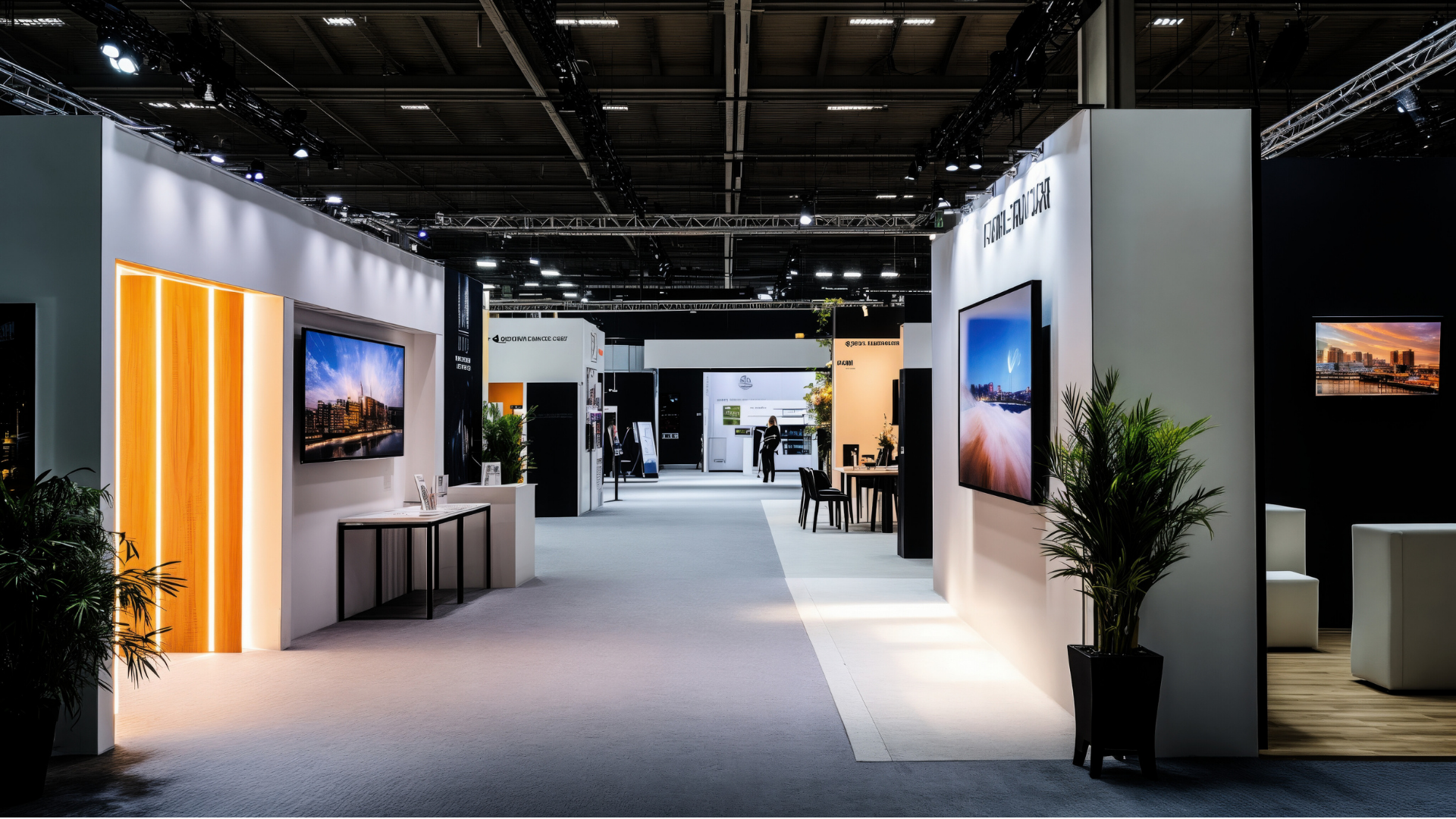
Summary: Setting up and taking down an exhibition stand often takes more time than it should, and it's rarely the staff's fault. It's because the wrong tape was chosen for the wrong task and no one had a plan for how to take it down as quickly as it went up. This guide will show you how to choose the right products for each phase of the setup, from floor fixing to clean removal.
It's five in the morning, the setup day for a three-day exhibition is starting, and the stand needs to be ready by nine for opening. It's at this point that material choices make themselves felt. The floor mat won't stay put. The double-sided tape ordered in advance works on parquet flooring, but this hall has concrete floors. The cable taping doesn't hold along the wet walkway outside. And no one really knows which tape is okay for the floor without damaging it.
This is a scenario that repeats often enough for it to be a planning issue, not an accident. Optimizing the setup and dismantling of an exhibition stand largely involves making material decisions in the planning phase, not on site under time pressure. The right tape for the right phase not only saves time during setup – it saves potential claims for damages during dismantling and directly affects how quickly you can leave the venue and move on.
Three phases guide material selection: assembly, where everything needs to be set up quickly and securely; the exhibition period, where the material must withstand traffic and load; and dismantling, where everything must be removed cleanly and quickly without leaving traces. The products that work in all three phases are rarely the same.
Planning that saves time during setup
The most common waste of time during an exhibition setup is not the tasks that take time but the decisions that are made repeatedly on site. Which tape for that floor? How do we tape the cable around that corner? Do we bring more double-sided tape tomorrow? All these questions can be answered in advance if the material list is specific enough.
A functional material list divides tasks by phase and assigns a specific product per task. For floor fixing on delicate surfaces: tesa 4939. For heavier elements on concrete: tesa 4964. For cables and rigging elements: tesa 4688 50mm x 50m. Not "gaffer tape" as a category, but a specific product with a specific format and a specific task.
This time saving doesn't happen during the first rigging but during the third. When the team knows which product belongs to which task, anyone can proceed without asking. And when you notice that tesa 4939 ran out on day one, you can order the correct quantity for next time instead of just making do with what's available.
Use tesa 4688 to secure cable runs along stand walls and behind stage elements, to temporarily tape loose rigging elements, and to bundle cables along the floor against a wall. The 50m format means you don't have to change rolls in the middle of a long run. Use tesa 53949 50mm x 50m when the cable run is along a high-traffic walkway – its stronger natural rubber adhesive handles mechanical stress better.
Floor fixing – what holds and what gets damaged
The floor is the surface that causes the most problems during dismantling. A tape that has been on a polished exhibition floor or a lacquered wooden floor in a rented venue for three days can leave residues that take hours to remove, or in the worst case, damage the surface. This is not an unlikely outcome – it's a predictable result of choosing a product without considering the sensitivity of the surface and the exposure time.
Use tesa 4939 to secure entrance mats and floor elements to sensitive surfaces. The product's differentiated adhesion – stronger to the mat, gentle to the surface – means it can be removed without leaving residues on most standard exhibition floors. Always apply to a clean and dry floor, and remove the tape at a sharp angle to the surface, not straight upwards.
tesa 4964 is used when the element to be fixed is heavier – stage platforms, podiums, and heavier stand constructions. It provides a stronger hold and is suitable for more robust surfaces like concrete and exhibition board. Always plan the removal of tesa 4964 within a reasonable time after the exhibition – the adhesive activates deeper the longer it stays on.
A routine that prevents most problems: always test on a hidden corner of the floor the first time you set up in a new venue. It takes five minutes and provides a concrete answer as to whether the product works on that specific surface. The result is documented and saved in the material list for the next time in the same hall.
Cables and marking during the exhibition period
The exhibition period places different demands than setup. During setup, time pressure is high and tasks are clear. During the exhibition period, it's stability that is tested. Cables that come loose under visitor traffic, markings that start to lift halfway through day two, and elements that shift during continuous visitor flow – all these problems stem from material choices made during setup.
Use tesa 53949 for cable runs along walkways that need to withstand three days of visitor traffic without supervision. The natural rubber adhesive maintains its adhesion strength during temperature variations and mechanical stress. Apply the tape in segments of 60–80 cm with a short gap in between, rather than in one long continuous run. This allows each segment to adhere optimally and makes it easier to fix a loose section without having to remove the entire run.
Etab 3336 All-purpose Fabric Tape 48mm x 50m is used for quick assembly jobs behind exhibition booth walls, for cable bundling behind stage elements and for marking rigging elements with permanent marker. It is a cost-effective all-round product that handles most backstage tasks without drawing resources from more specialized products.
Marking tape for walkways and stage zones is handled separately. Use tesa 4671 Fluorescent 50mm x 25m for escape routes and stage zone boundaries that need to be clearly visible throughout the event, including in low light.
Disassembly without residue – quick breakdown and venue in original condition
Disassembly is the phase that is most often underestimated in planning and costs the most in reality. A venue that needs to be returned three hours after the fair ends, tired staff and cables that need to be removed, and tape that doesn't want to come off cleanly – that's a combination that creates stress and potential claims for compensation.
Nichiban 50mm x 25m is the product for assembly jobs that require clean removal. It is a gaffer tape with natural rubber adhesive that leaves minimal residue with correct removal and is chosen by production teams in venues with strict surface requirements. Use Nichiban for all taping directly onto rented surfaces – exhibition booth walls, stage decor and textiles that need to be returned in original condition, and for markings that remain longer than 24 hours on sensitive surfaces.
Three concrete removal rules that eliminate most residues: always lift the tape at a sharp angle to the surface, not straight upwards. Lift the tape slowly and evenly, not quickly – quick removal increases the risk of the adhesive remaining. Lift the tape preferably within the recommended exposure time and do not let the tape sit long after it is no longer needed.
FAQ
1. Which double-sided tape is best for aisle carpets on exhibition floors?
tesa 4939 is the standard choice for aisle carpets on exhibition floors. Its differentiated adhesion adheres firmly to the carpet and is gentle on the surface, making it possible to remove without leaving residue on most standard exhibition floors with correct removal. Always apply to a clean and dry surface – dust under the tape is the most common reason for it to come off prematurely. Pull the tape at a sharp angle to the surface when removing, not straight upwards. Always test a hidden corner of the floor in a new venue before taping a whole aisle carpet – it provides a concrete answer to how the tape behaves on that specific surface.
2. Can the same tape be used for assembly and disassembly?
Yes, in the sense that you choose a product that can handle both phases. Nichiban is a clear example: it adheres well during the exhibition period and is removed cleanly without residue – it is designed for exactly that combination. tesa 4939 achieves a similar profile for floor applications. What doesn't work, however, is to use an aggressive product like tesa 4964 on sensitive surfaces with the expectation of clean removal – tesa 4964 is built for strength, not for gentle removal. Choose the product based on what the removal requires, not just what the assembly requires.
3. How can you speed up disassembly without leaving residue?
Three factors determine how quickly disassembly goes cleanly: product choice, exposure time, and removal technique. The right product choice is the foundation – Nichiban and tesa 4939 are designed for clean removal. Exposure time matters – tape that has been applied for a shorter time comes off easier and cleaner. Removal technique is what determines the final step: always lift the tape at a sharp angle to the surface, and go slowly. Tape that is removed too quickly leaves more residue than tape that is removed methodically. Practice makes it faster – a team that knows how removal works disassembles in half the time.
4. Which gaffer tape holds best along cable runs with traffic?
tesa 53949 50mm x 50m is the product for cable runs under visitor traffic. The natural rubber adhesive retains its adhesive strength during temperature variations and under mechanical stress, and the 50mm format covers most cable widths with sufficient margin. Apply the tape in segments with short gaps instead of a single long stretch – this provides better adhesion to the surface and allows a loose section to be fixed without removing the entire run. Always check that the surface is clean and dry before taping. Tape that starts to lift at the edges is almost always due to dust or moisture under the tape during application, not the product.
5. How do you choose tape if you don't know the type of surface in the venue?
Test before taping the entire surface. Place a piece of tesa 4939 in an inconspicuous corner, leave it for a couple of hours, and then remove it at a sharp angle. This will provide a concrete answer without risk of damage. If the surface turns out to be uneven, porous concrete, or an unknown coating material: choose Orafol 1450 which has a more aggressive adhesive designed for more uneven surfaces, or contact the venue to ask what material is approved for their floors. This information is valuable to have documented for future productions in the same venue.
6. How much tape do you need for a standard exhibition booth?
It varies depending on booth size and cable quantity, but a guideline for a 6×3 meter booth over three days: 2–3 rolls of tesa 4688 for cable management and rigging elements, 1–2 rolls of tesa 4939 for floor fixation and 1 roll of Nichiban for assembly jobs on delicate surfaces. This is a starting point, not a definitive answer. Document consumption after each exhibition and build up your own reference value based on the productions you actually do – it is more relevant than general estimates.
7. Can gaffer tape that was removed cleanly be reused?
Generally no. Tape that has been removed has lost some of its original adhesive strength. The rubber adhesive is activated against the surface during application and loses its original character once it has been removed. tesa 53949 and Nichiban can, with short exposure times and careful removal, sometimes be reused for individual light assembly jobs, but don't count on it as plan A. In a production environment, tape is a consumable and should be budgeted as such – the cost of reusing tape that doesn't adhere well is always higher than the cost of a new roll.
8. How do you document material choices to streamline future exhibitions in the same venue?
Simplest: an A4 sheet with three columns – product, task, surface – filled in during or immediately after the rigging. Add a column for whether the removal was clean. It takes ten minutes to fill in and provides a valuable reference document that saves time at the next production in the same venue. Feel free to photograph cable runs and floor solutions after the rigging. The combination of image and material list allows the entire team to rig identically next time, regardless of who was there last time. Save the document per venue, not per event – a venue recurs, an event rarely does.
Share article:
Which tape works best on concrete floors (2026)
How to store tape for longer shelf life (2026)